Well Pump Pressure Switch: Settings, Adjustment and Troubleshooting
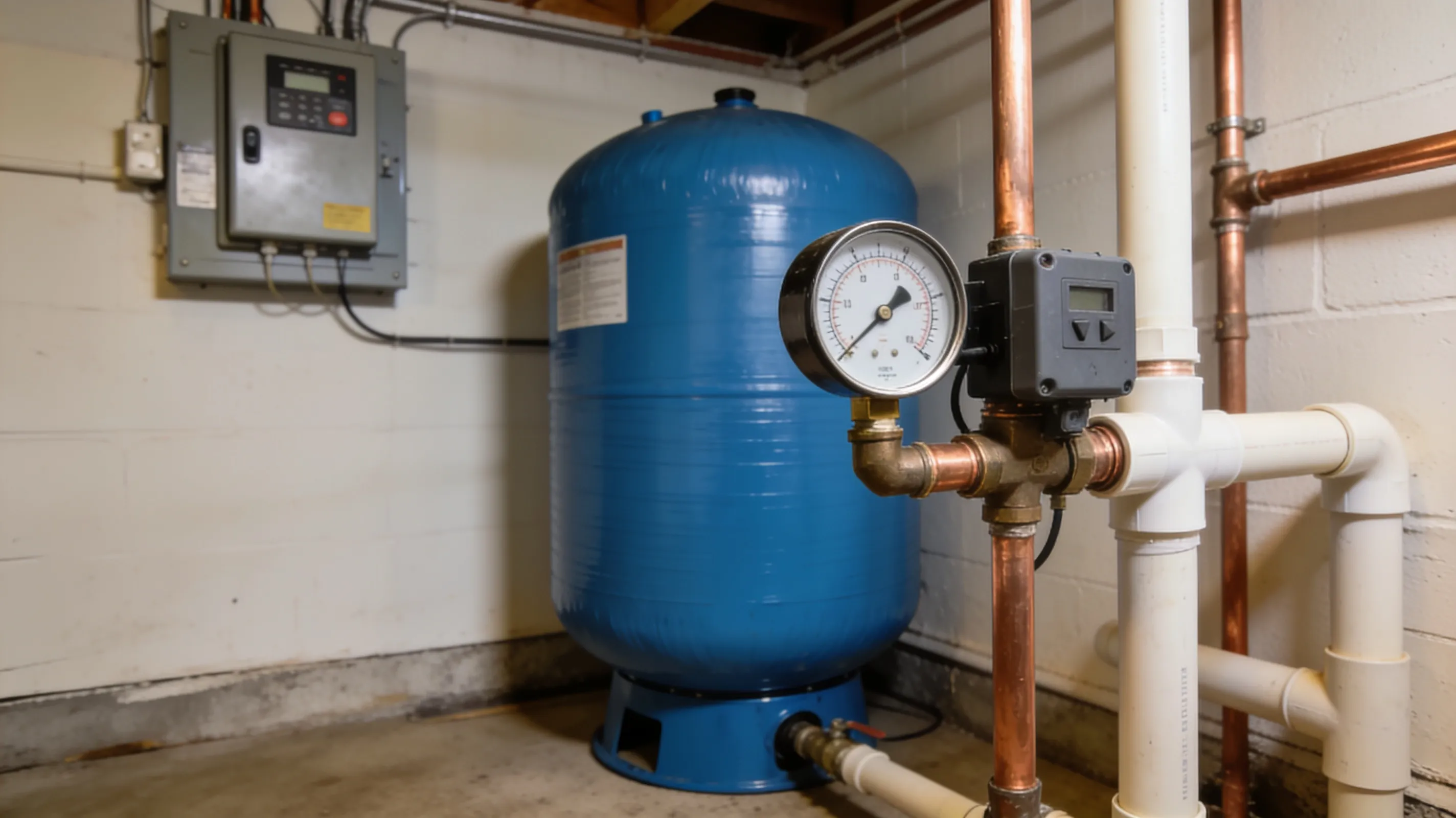
The pressure switch is the small gray box that tells your well pump when to start and stop. Here's how to read its settings, adjust it safely, and tell a switch problem from a tank or pump problem.
What the numbers mean
| Setting | Pump turns ON at | Pump turns OFF at | Tank precharge |
|---|---|---|---|
| 30/50 | 30 PSI | 50 PSI | 28 PSI |
| 40/60 | 40 PSI | 60 PSI | 38 PSI |
| 50/70 | 50 PSI | 70 PSI | 48 PSI |
Higher settings give stronger showers but make the pump work harder and need a tank and plumbing rated for the pressure. The precharge column follows AMTROL's rule (2 PSI below cut-in).
How to adjust a well pressure switch
- Turn off the pump's breaker. Confirm it's off.
- Remove the switch cover. You'll see two springs on threaded posts: a large range nut and a smaller differential nut.
- Cut-in: turn the large range nut clockwise to raise the cut-in pressure, or counterclockwise to lower it. On many switches this moves cut-in and cut-out together.
- Cut-out: turn the small differential nut clockwise to raise the cut-out pressure (a wider gap), or counterclockwise to lower it.
- Make small changes (a turn or two), replace the cover, restore power, and watch the gauge through a full cycle. Repeat as needed.
- Set the pressure tank precharge to 2 PSI below your new cut-in.
Steps 3–4 follow Schneider Electric's instructions for the Square D 9013FSG. Other brands are similar, but check your model's label or manual. Some models have only one adjustment.
Troubleshooting
| Problem | Check first |
|---|---|
| Pump won't start | Breaker or fuse; low-pressure cut-off lever tripped (on models that have one); burned or pitted switch contacts; clogged pressure tube under the switch |
| Pump won't shut off | Cut-out set higher than the pump can reach; low water level in the well; a leak; worn pump; clogged pressure tube. Turn it off if it runs with no water use. |
| Rapid on/off cycling | Usually the pressure tank: low air charge or failed bladder |
| Switch chatters or buzzes | Worn contacts, or a pressure tube partly clogged with sediment or iron |
| Low pressure everywhere | Switch setting, tank precharge, clogged sediment filter, or a failing pump |
When to replace the switch
- Contacts are badly pitted or burned
- The switch leaks water or the diaphragm has failed
- It won't hold a setting after adjustment
A pressure switch is an inexpensive part. Replacing it means working with line voltage, so use a licensed contractor or electrician if you're not experienced. When a pump keeps failing to start, rule the switch out before paying for a new pump.
Frequently asked questions
What should my well pump pressure switch be set at?
The most common settings are 30/50 and 40/60 PSI (pump turns on at the first number, off at the second). Square D’s standard Pumptrol models, for example, come factory-set at 30-50 or 40-60. Choose a setting your pump can reach and your tank and plumbing are rated for.
How do I adjust a water well pressure switch?
With power off at the breaker: turn the large range nut to set the cut-in (clockwise raises it), then the small differential nut to set the cut-out (clockwise raises it). Then reset the tank precharge to 2 PSI below the new cut-in. Schneider Electric documents this order for its 9013FSG switch.
Why won’t my well pump shut off?
Common causes are a cut-out set higher than the pump can reach, a well with a low water level, a worn pump, a leak, or a clogged pressure switch tube. Turn the pump off if it runs continuously with no water use, because running dry damages pumps.
Why does my well pump turn on and off rapidly?
Rapid cycling is most often a waterlogged pressure tank or low tank air charge, not the switch. Check the tank precharge first.
Is it safe to adjust a pressure switch myself?
Only with power off at the breaker. InspectAPedia warns that removing the cover exposes live electrical contacts. If you are not comfortable, a licensed well or pump contractor can do it.
Sources
- How do you adjust the settings on a 9013FSG switch?, Schneider Electric (Square D)
- How to adjust a well pump pressure control switch, InspectAPedia
- Well tank FAQs (precharge, winterizing, replacement signs), AMTROL
- 7 Signs Your Well Pump Is Not Well, HomeServe
Sources checked October 24, 2026. Found an error? Tell us and we will fix it.