Orange Stains From Well Water: Causes, Tests and Fixes
Orange, rust-colored stains on sinks, toilets and laundry almost always mean iron in your well water. The fix depends on which kind of iron it is and how much.
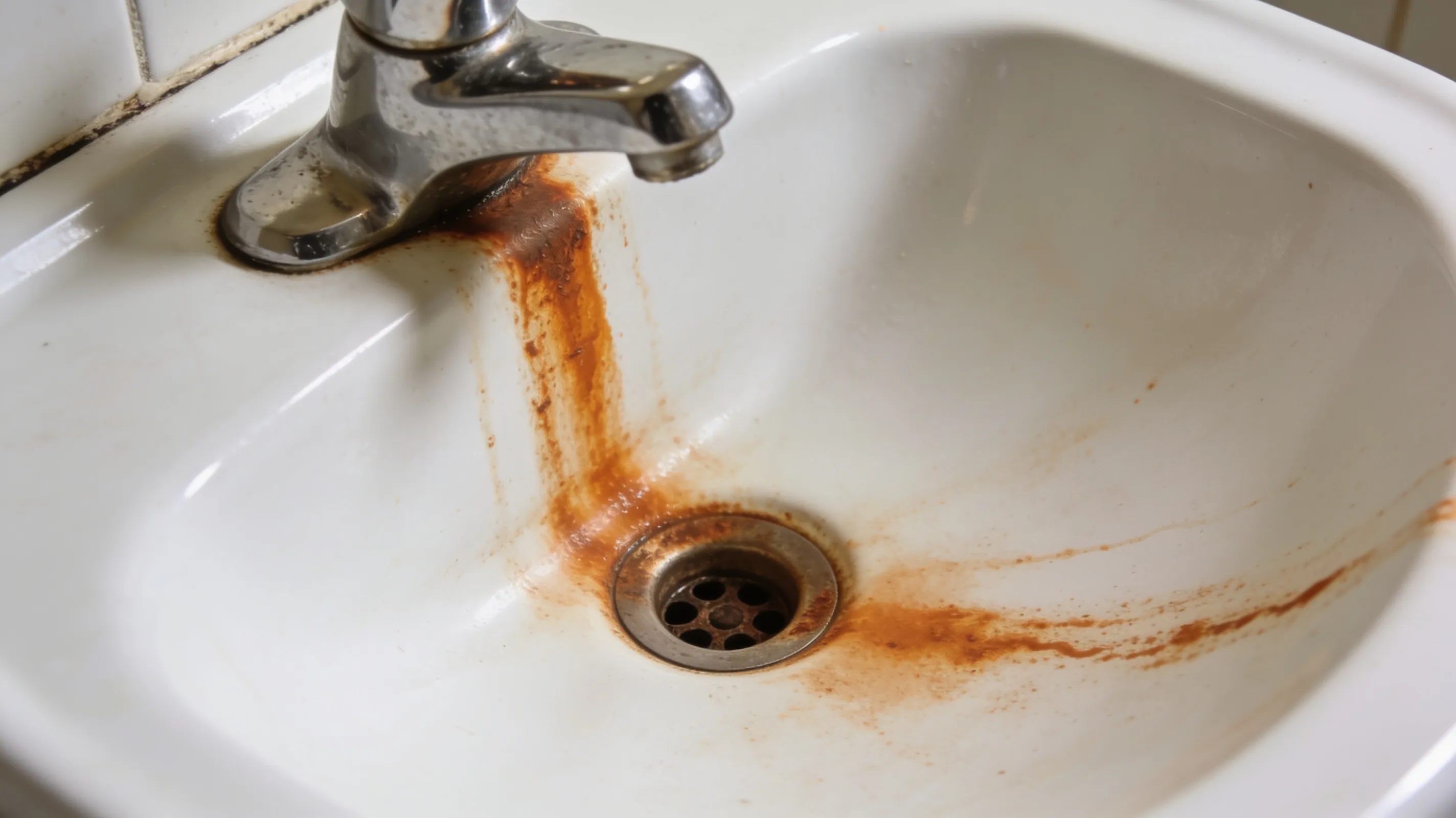
Which kind of iron do you have? The glass test
Fill a clear glass with cold water from the tap nearest the well, before any filter. Look at it right away, then again after a few hours.
| What you see | Likely cause | What it means for treatment |
|---|---|---|
| Clear at first, turns orange or brown as it sits | Dissolved (ferrous) iron | Needs to be oxidized, then filtered. A plain sediment filter won't catch it. |
| Orange or cloudy straight from the tap, particles settle | Rust particles (ferric iron) | Already oxidized. A sediment filter can catch it, if the level is low. |
| Slimy orange-brown film in the toilet tank, oily sheen, swampy smell | Iron bacteria | Treat the well (shock chlorination) before or alongside filtration. |
| Only the first water in the morning, or only hot water | Your plumbing (old iron pipes or the water heater) | The well water may be fine. Test a sample taken straight from the pressure tank. |
Why well water has iron
Iron is one of the most common elements in soil and rock. Groundwater dissolves it, especially when the water is low in oxygen or slightly acidic. Iron often comes with manganese, which leaves black or dark brown stains instead. Penn State Extension notes that the two often occur together, with manganese usually at much lower levels.
The EPA lists iron as a secondary contaminant. Its 0.3 mg/L guideline is based on taste, color and staining, not health. Private wells aren't covered by federal drinking water rules, so testing is up to you.
What to test for (and why not just iron)
A cheap iron test strip tells you iron is there. It doesn't tell you enough to buy the right equipment. Ask a certified lab for:
- Iron (total, and dissolved if offered): sets which treatment you can use
- Manganese: harder to remove than iron, and it changes which filter works
- pH: many oxidizing filters only work in a certain pH range
- Hardness: decides whether a softener should be part of the system
- Hydrogen sulfide (if you smell rotten eggs)
- Total coliform bacteria: a basic safety check every well owner should run regularly
Many state and county health departments offer low-cost well testing. Check with yours before buying a private lab kit.
Fixes, matched to your test result
Every product has a rated limit for iron (and usually for manganese and pH). Rated limits vary by model, so always compare your lab number to the maker's spec sheet. The ranges below are general guidance from extension sources, not guarantees.
| Treatment | Best for | Watch out for |
|---|---|---|
| Sediment filter (spin-down or cartridge) | Rust particles that are already visible | Does nothing for dissolved iron. Clogs fast at high levels. |
| Water softener rated for iron | Low levels of dissolved iron in hard water | Iron fouls the resin over time. Not suited to rust particles or iron bacteria. |
| Oxidizing filter (air injection, manganese greensand, catalytic media) | Moderate dissolved iron, the most common whole-house fix | Each medium has pH and iron limits. Needs backwashing, so it needs a drain. |
| Chemical injection (chlorine or hydrogen peroxide) + filter | High iron, iron bacteria, or iron mixed with sulfur smell | More equipment and upkeep. Usually needs a contact tank and a carbon filter after it. |
| Shock chlorination of the well | Iron bacteria | A treatment, not a cure. Bacteria often come back, so it may need repeating. |
NDSU and Penn State both stress the same point: choose treatment from a lab result, not from the stain. Two homes with identical orange sinks can need completely different systems.
How to remove the orange stains
- Don't use chlorine bleach on rust stains. It can set them permanently.
- Use a cleaner labeled for iron or rust stains (many contain oxalic acid). Wear gloves and follow the label.
- For laundry, use a rust stain remover made for fabric, and wash stained items again only after the water is treated.
- Stains come back until the iron is treated at the source, so fix the water first, then clean.
Related problems
- Black or dark brown stains (manganese)
- Tea-colored water that doesn't settle (tannins)
- Rotten egg smell (hydrogen sulfide, often found with iron)
- Cloudy water
- Metallic taste (iron, or corroding pipes)
Frequently asked questions
Is orange well water safe to drink?
Iron itself is mainly a nuisance. The EPA lists it as a secondary (non-health) contaminant with a guideline of 0.3 mg/L, based on taste and staining. But orange water can come with other problems, such as iron bacteria or, in shallow wells, surface water getting in. Test for bacteria too, not just iron.
Why does my well water come out clear and turn orange later?
That is dissolved (ferrous) iron. It is invisible underground where there is no oxygen. Once it meets air in a glass, toilet tank or sink, it oxidizes into orange-brown rust particles.
Will a water softener remove iron?
A softener can remove small amounts of dissolved iron if it is rated for it, but it is not an iron filter. Higher iron, iron that has already turned to rust, or iron bacteria will foul the softener resin. Check your test result against the softener maker’s rated iron limit before relying on one.
Can I use bleach on rust stains from well water?
No. Chlorine bleach can set rust stains and make them permanent. Use a cleaner made for iron and rust stains (often based on oxalic acid) and follow the label.
What is the slimy orange stuff in my toilet tank?
Slimy or gelatinous orange-brown deposits usually mean iron bacteria. They are generally not a health risk, but they cause odors and clog plumbing and treatment equipment. Shock chlorination is the usual first step.
Sources
- Secondary Drinking Water Standards: Guidance for Nuisance Chemicals, U.S. EPA
- Iron and Manganese in Private Water Systems, Penn State Extension
- Iron & Manganese in Private Drinking Water Wells, UMass Amherst
- Iron and Manganese Removal, NDSU Extension
- Iron Bacteria in Well Water, Minnesota Department of Health
- Shock Chlorination of Wells and Springs, Penn State Extension
- Private Drinking Water Wells, U.S. EPA
Sources checked October 26, 2026. Found an error? Tell us and we will fix it.